

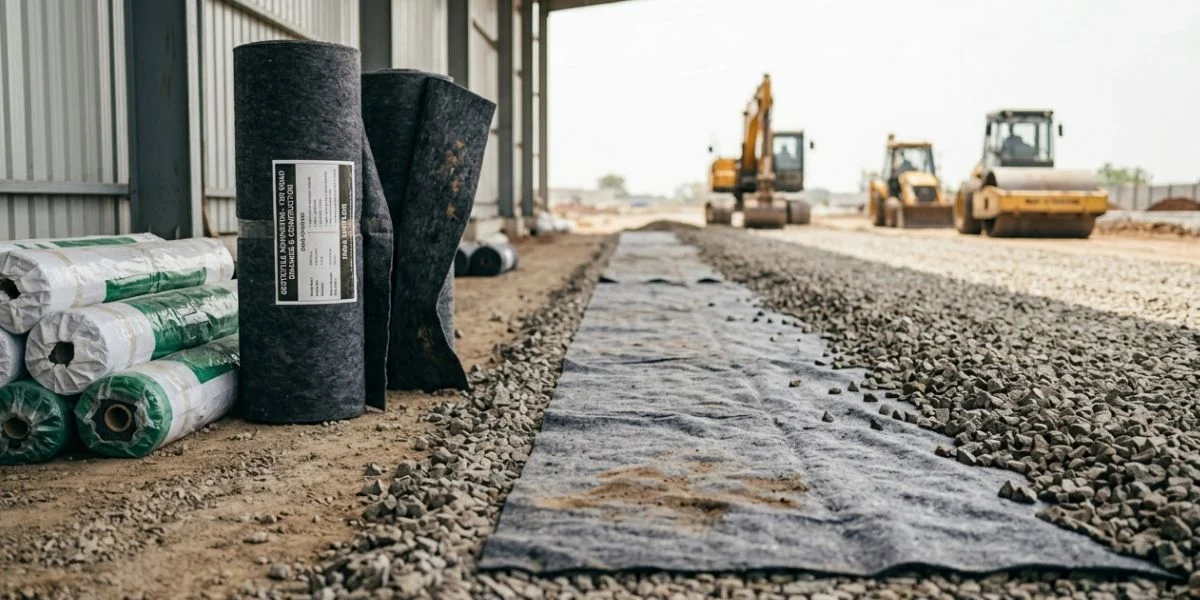
Geotextile Nonwoven for Road Drainage & Construction — India Supplier
Geotextile nonwoven fabric performs four critical functions in road and drainage construction: separation (preventing subgrade and aggregate mixing), filtration (allowing water flow while retaining soil particles), drainage (conveying water within the structure), and reinforcement (adding tensile strength to weak subgrade). Favourite Fab supplies geotextile for Indian road construction contractors, irrigation departments, railway projects, and infrastructure developers — with IS 14324 and ASTM D4595 compliance documentation for government tender submissions.
Browse our full range: View all nonwoven fabric products — spunlace, spunbond, SMS, bico — with GSM, width and certification options. B2B MOQ from 500 kg.
Function Selection Guide
| Function | GSM Required | Key Property | Application |
|---|---|---|---|
| Separation | 100–200 GSM | Tensile + CBR puncture | Road base over weak subgrade |
| Filtration | 80–150 GSM | AOS (apparent opening size) | Drainage pipe wrap, retaining wall |
| Drainage | 200–400 GSM (thick) | In-plane permeability | Drainage blanket behind retaining walls |
| Reinforcement | 200–600 GSM | High tensile (>30 kN/m) | Steep slope, embankment over soft soil |
FAQ
What geotextile specification is required for NHAI road projects?
NHAI standard specifications require IS 14324 compliant geotextile with minimum tensile strength 20 kN/m, CBR puncture ≥2,500 N, AOS 0.075–0.212 mm for separation applications. Always confirm with project-specific drawing and schedule of rates before ordering.
Is third-party test certificate required for government geotextile tenders?
Yes — most government road tenders require NABL-accredited laboratory test report confirming GSM, tensile, CBR, and AOS per IS 14324. Favourite Fab provides third-party test certificates for geotextile grades. Specify tender requirement at time of enquiry.
Full range: spunbond nonwoven fabric manufacturer India. Related: PP needle punch geotextile nonwoven 100–600 GSM.
B2B Applications & End-Uses
Geotextile nonwoven fabrics serve as the structural backbone of modern civil infrastructure projects across India and international markets. In road construction, PP needle-punched geotextiles installed at the subgrade–aggregate interface perform the critical separation function — preventing fine-grained subsoil particles from migrating upward into the granular sub-base under repeated traffic loading, which would otherwise cause premature rutting and bearing capacity loss. The same fabric simultaneously provides planar drainage, channelling pore water laterally away from the pavement structure and reducing hydrostatic pressure buildup that leads to frost heave in colder climates.
Railway applications demand higher GSM grades (typically 300–600 GSM) to withstand dynamic ballast loading. Geotextile placed beneath railway ballast prevents subgrade contamination, maintains track geometry over longer maintenance intervals, and reduces life-cycle tamping costs — a compelling total-cost argument for infrastructure procurement teams operating under tight OPEX budgets.
Retaining wall and reinforced earth structures use geotextile as both a separation and drainage layer behind the wall face, allowing hydrostatic pressure dissipation while retaining backfill fines. Drainage trench applications specify geotextile-wrapped perforated pipe systems (French drains), where AOS (Apparent Opening Size) selection is critical — too open and fines migrate into the drain; too tight and permeability drops below design flux requirements.
Landfill liner systems incorporate geotextile as a protection layer over geomembrane, cushioning against puncture from overlying drainage aggregate. In leachate collection layers, needle-punched geotextile with high in-plane transmissivity (ASTM D4716) conveys leachate to collection sumps. Airport runway sub-base stabilisation, port container yard pavement, and industrial hardstand construction represent high-volume procurement segments where Favourite Fab supplies direct to EPC contractors and government infrastructure departments.
Certifications & Quality Assurance
Every geotextile grade manufactured at Favourite Fab’s Agra facility is tested against IS 16392 (Indian Standard for Geosynthetics — Geotextiles and Geotextile-Related Products), the primary specification referenced in NHAI, MoRTH, and state PWD tender documents. Test parameters include mass per unit area (IS 1964), thickness under load (ISO 9863-1), grab tensile strength and elongation (ASTM D4632), trapezoid tear (ASTM D4533), CBR puncture resistance (EN ISO 12236), and burst strength (ASTM D3786).
Hydraulic properties are verified per ASTM D4491 (water permeability / permittivity) and ASTM D4751 (AOS by dry sieving). In-plane transmissivity for drainage grades is measured per ASTM D4716 under specified normal stress conditions that replicate field loading. All test results are documented in batch-specific quality certificates traceable to the production lot.
For export projects requiring international compliance, AASHTO M288 (Geotextile Specification for Highway Applications) and ISO 10318 series documentation is available. Third-party testing through NABL-accredited laboratories is facilitated on request for government and multilateral-funded infrastructure tenders. Our internal QC programme includes in-line GSM monitoring every 100 metres of production, tensile verification at shift intervals, and finished-roll AOS spot checks.
More Questions Answered
What GSM geotextile is required for national highway sub-base applications under MoRTH specifications?
MoRTH Clause 309 for geosynthetics in road construction typically specifies a minimum tensile strength threshold rather than a fixed GSM, but needle-punched PP geotextile in the 150–300 GSM range is most commonly specified for sub-base separation in NH projects. The correct GSM is selected based on subgrade CBR, traffic loading (commercial vehicle axle load), and site-specific soil gradation analysis. Favourite Fab provides application engineering support to help procurement teams identify the correct grade for their specific project geotechnical report.
Can geotextile nonwoven be supplied pre-cut to trench width specifications for drainage projects?
Yes — Favourite Fab supplies geotextile in slit rolls cut to standard trench widths (typically 1.0m, 1.2m, 1.5m, and 2.0m) or to custom dimensions as specified in project drawings. Pre-cut supply reduces site wastage and simplifies installation for drainage trench wrapping applications. Minimum order quantities apply for non-standard widths; please share your project specification sheet when requesting a quote.
Related B2B Resources

Gaurav Garg
I'm Gaurav Garg, CEO of Favourite Fab, a company on a mission to revolutionize the nonwoven industry with sustainable practices. We work hand-in-hand with manufacturers and suppliers who share our commitment to eco-friendly production. With a deep interest in textile innovation, I'm passionate about educating consumers about sustainable material options and their potential to transform the nonwoven landscape.


