

Perforation and Aperturing Nonwoven — Laser vs Mechanical Process India
Perforation and aperturing nonwoven processes create controlled hole patterns in fabric to manage fluid flow, breathability, and tactile performance. Favourite Fab supplies apertured and perforated nonwoven as an upstream raw material to hygiene manufacturers, medical device producers, and wound care converters across India and globally. This guide covers both laser and mechanical aperturing processes, specifications, and sourcing options.
What Is Perforation and Aperturing in Nonwoven Fabric
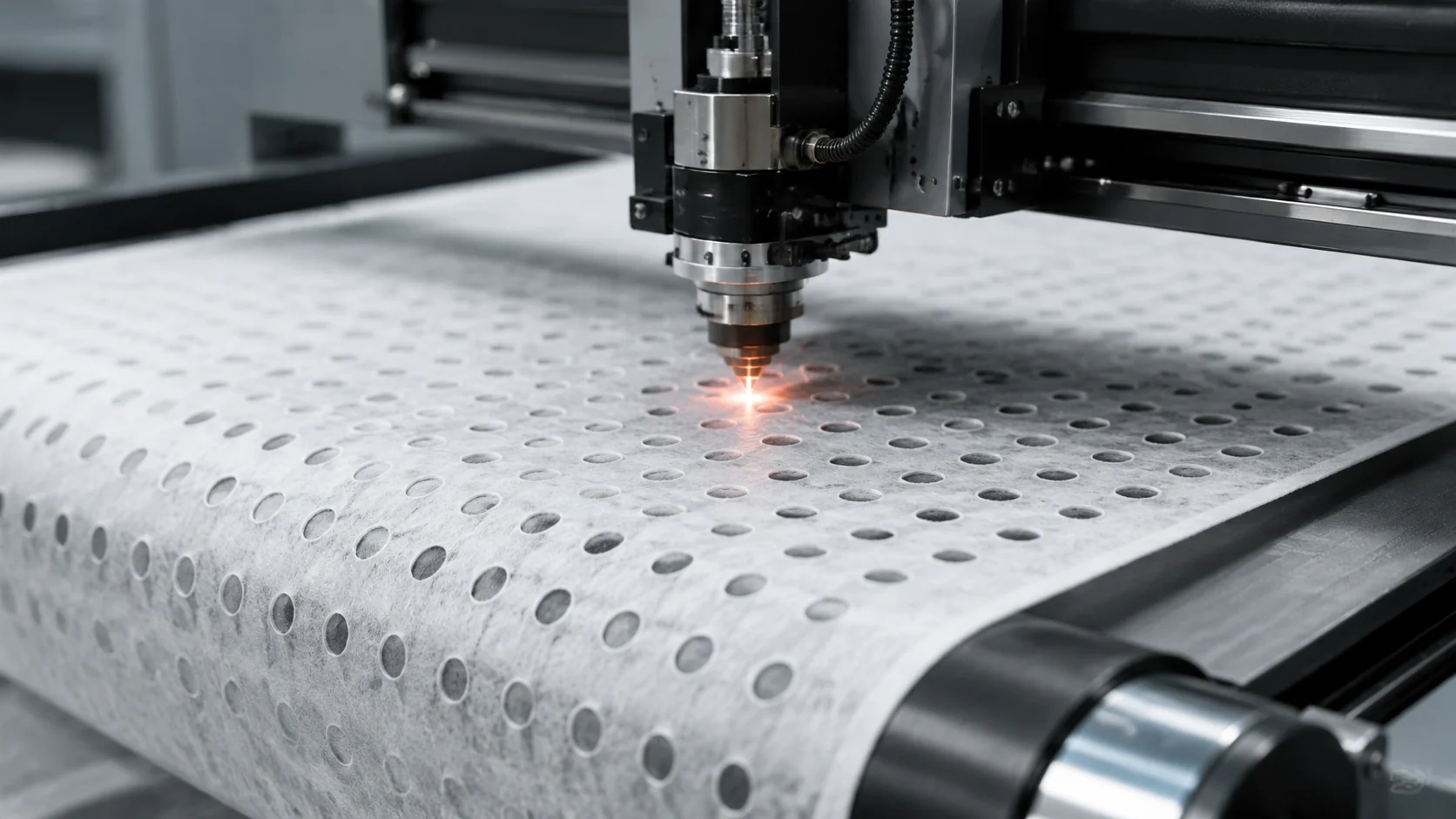
Aperturing is the process of creating openings — holes or slits — in a nonwoven web at defined pitch, size, and geometry. These openings control how quickly fluid passes through the fabric, how much air flows, and how the fabric feels against skin.
In hygiene products, apertured topsheets allow urine or menstrual fluid to pass rapidly into the absorbent core while minimising rewet. The hole geometry, open area percentage, and fabric basis weight determine strike-through rate and skin dryness perception.
Two primary methods exist for aperturing nonwoven: laser perforation and mechanical aperturing. Each method produces different edge profiles, hole geometries, and scale economics. Choosing between them depends on your product specification, production speed, and cost requirements.
Laser vs Mechanical Aperturing — Process Comparison
Apertured Nonwoven — Specifications and Options
Favourite Fab supplies mechanically apertured and perforated nonwoven rolls for hygiene and medical converter applications. Standard and custom hole patterns are available.
| Parameter | Specification | Detail |
|---|---|---|
| Aperturing Method | Mechanical (needle/pin roll) | Laser aperturing on specific grades |
| Base Fabric | PP spunbond, PE/PP bico, SMS | Spunlace and airlaid on request |
| Basis Weight (pre-aperture) | 12–40 gsm | Most hygiene topsheet grades: 15–22 gsm |
| Hole Diameter | 0.3–5.0 mm | Custom hole geometry (round, oval, diamond) |
| Open Area | 8–35% | Higher open area = faster fluid strike-through |
| Hole Pitch | 1.0–5.0 mm centre-to-centre | Staggered or in-line pattern available |
| Surface Finish | Hydrophilic / Hydrophobic | Lotion or aloe vera coating available |
| Roll Width | Up to 1,600 mm | Slit to converter widths from 100 mm |
Applications in Hygiene and Medical Manufacturing
Perforation and aperturing nonwoven technology is essential in products that require controlled fluid management at the skin interface.
- Sanitary napkin and panty liner topsheets: apertured nonwoven is the primary topsheet substrate. Hole size and open area govern fluid transfer rate and skin dryness. See our apertured nonwoven topsheet page for dedicated topsheet grades.
- Baby diaper topsheets: apertured PE/PP bico provides rapid urine acquisition with minimal rewet at the skin surface.
- Wound dressings: precisely apertured nonwoven carriers in advanced wound care allow exudate to move to the absorbent layer without sticking to the wound bed.
- Incontinence pads: heavier-basis-weight apertured fabrics for adult incontinence topsheets handling higher fluid volumes.
- Wet wipes substrates: laser-apertured spunlace for premium wet wipes and cosmetic pads with textured cleaning surfaces.
- Agricultural and filtration fabrics: controlled-aperture nonwoven for root barriers, drainage fabrics, and particle-size filtration.
Perforation and aperturing nonwoven choice also affects calender bonding downstream — apertured fabrics require adjusted nip pressure to avoid hole distortion during secondary processing. The base fabric category is covered under our spunlace nonwoven range for wetlaid apertured substrates.
Laser vs Mechanical Aperturing — When to Choose Each
Mechanical aperturing is the standard choice for high-volume hygiene production. Pin rolls create holes at speeds up to 500 m/min and require no energy-intensive laser systems. Die tooling costs are moderate and amortised quickly at volume.
Laser perforation suits premium applications where hole precision, minimum hole size below 300 microns, or clean fused edges are required. Laser aperturing produces no fibre displacement — the edge is fused by heat, eliminating fraying or loose fibres that could affect skin feel or wound contact safety.
For most sanitary napkin and diaper topsheet applications, mechanical aperturing at 0.5–2.0 mm holes provides the best cost-performance ratio. For wound care and medical device applications requiring sub-millimetre precision and clean edges, specify laser-perforated grades.
Why Source From Favourite Fab
- MOQ-friendly — suitable for small and large manufacturers
- Export-ready — ships raw materials to 50+ countries
- ISO certified manufacturing facility
- 10+ years supplying the hygiene and medical industry
- Custom specifications available on request
Pricing and MOQ
Apertured nonwoven pricing depends on base fabric type, basis weight, hole pattern complexity, and finishing requirements. Standard mechanically apertured PP spunbond topsheet grades are priced competitively for volume hygiene manufacturers. Laser-perforated grades and custom hole geometries carry additional processing charges.
Minimum order quantities start from 500 kg for standard mechanically apertured grades. Custom patterns and laser grades require 1,000 kg minimum. Contact the sales team with your required base fabric, GSM, hole diameter, open area percentage, and monthly volume for a precise quote.
How to Order
- Send your material requirements to sale@favouritehub.com
- Receive a quote and sample within 48 hours
- Confirm order and production begins
Frequently Asked Questions
What is the difference between perforation and aperturing in nonwoven fabric?
Aperturing refers to creating holes or openings in a nonwoven web to manage fluid flow, breathability, and tactile performance. Perforation is a specific form of aperturing that uses needle rolls, pins, or laser beams to punch discrete holes at a defined pitch. In practice, both terms are used interchangeably in the hygiene and medical nonwoven industry. The key variable is hole size, shape, and edge quality — not the name of the process.
Which aperturing method is better for sanitary napkin topsheets?
Mechanical aperturing is the standard for sanitary napkin topsheets. Pin-roll mechanical processes produce holes at 0.5–2.0 mm diameter at speeds up to 500 m/min, which is compatible with high-volume hygiene converter lines. Laser aperturing is reserved for premium applications requiring sub-300-micron holes or clean fused edges. Most topsheet specifications in the hygiene industry are met by mechanical aperturing at a lower cost per square metre.
How does open area percentage affect topsheet performance?
Higher open area percentage — the proportion of the fabric surface that is holes — increases fluid strike-through speed. A fabric at 25–30% open area will allow fluid to pass to the absorbent core faster than a fabric at 10–12% open area. However, very high open area reduces fabric tensile strength and may allow core material to migrate upward toward the skin surface. Most hygiene topsheet grades are optimised at 15–25% open area.
Can Favourite Fab produce apertured nonwoven with a custom hole pattern?
Yes. Custom hole diameter, pitch, geometry (round, oval, diamond), and pattern layout (in-line or staggered) are available on development orders. Share a technical drawing or sample specification and the team will confirm feasibility, tooling cost, and minimum order quantity for the custom pattern. Standard patterns are available from stock for faster lead times.
Does aperturing affect the basis weight of the nonwoven fabric?
Aperturing removes material where holes are created, so the effective basis weight of the apertured zone is lower than the original fabric. For specification purposes, basis weight is measured on the intact fabric zones between holes. Customers should specify both the pre-aperture basis weight and the open area percentage to fully define the material. Favourite Fab provides both measurements on quality certificates.
What base fabrics can be apertured by Favourite Fab?
Favourite Fab apertures PP spunbond, PE/PP bicomponent spunbond, SMS composite, and spunlace nonwoven substrates. Each base fabric responds differently to mechanical and laser aperturing due to differences in fibre bonding, tensile strength, and melt behaviour. The sales team will recommend the most suitable aperturing method and process parameters for your specific base fabric and application.
Contact Favourite Fab
Email: sale@favouritehub.com
WhatsApp: +91-8800775462
Send your material specifications today for a same-day quote.
Related B2B Resources

Gaurav Garg
I'm Gaurav Garg, CEO of Favourite Fab, a company on a mission to revolutionize the nonwoven industry with sustainable practices. We work hand-in-hand with manufacturers and suppliers who share our commitment to eco-friendly production. With a deep interest in textile innovation, I'm passionate about educating consumers about sustainable material options and their potential to transform the nonwoven landscape.


