
US WIPPES Act Compliant Flushable Nonwoven Fabric
The US WIPPES Act (Wastewater Infrastructure Pollution Prevention and Environmental Safety Act) is reshaping how brands source flushable wipes raw materials. For OEMs, private-label manufacturers, and wipes brands supplying the North American market, sourcing US WIPPES Act compliant flushable nonwoven fabric is no longer optional — it is a regulatory requirement that directly affects market access. Favourite Fab supplies cellulose-based and spunlace nonwoven rolls engineered to meet flushability standards demanded by the US market.
What the US WIPPES Act Requires from Nonwoven Fabric
The WIPPES Act mandates that wipes labeled “flushable” must pass standardized flushability tests before they can be marketed in the United States. This places the compliance burden on the entire supply chain — from substrate supplier to finished product manufacturer. Key requirements impacting nonwoven fabric selection include:
- Fabric must disintegrate in wastewater conditions within defined time parameters
- No persistent synthetic plastic fibers in substrates labeled flushable
- Compliance documentation must be traceable from fiber to finished wipe
- FTC guidelines on labeling align with WIPPES Act enforcement
Brands that continue to use polypropylene or polyester spunlace for “flushable” labeling face FTC enforcement actions and state-level bans. The shift to cellulose and natural fiber blends is accelerating.
Favourite Fab Compliant Fabric Specifications
Favourite Fab manufactures spunlace nonwoven rolls using cellulose-dominant and natural fiber blends specifically designed for flushability compliance. Our fabric lines for this application include:
| Property | Standard Cellulose Spunlace | Cellulose/Viscose Blend | Cotton/Cellulose Blend |
|---|---|---|---|
| Fiber Composition | 100% Cellulose | 70% Cellulose / 30% Viscose | 50% Cotton / 50% Cellulose |
| GSM Range | 40–80 gsm | 45–90 gsm | 50–100 gsm |
| Flushability Profile | Excellent — rapid dispersal | Good — controlled dispersal | Good — biodegradable |
| Wet Strength | Moderate | Moderate-High | Moderate |
| Primary Applications | Moist toilet tissue, flushable wipes | Personal care flushable wipes | Premium flushable wipes |
| Typical Roll Width | 1.6m – 3.2m | 1.6m – 3.2m | 1.6m – 2.4m |
Flushability Testing Standards We Support
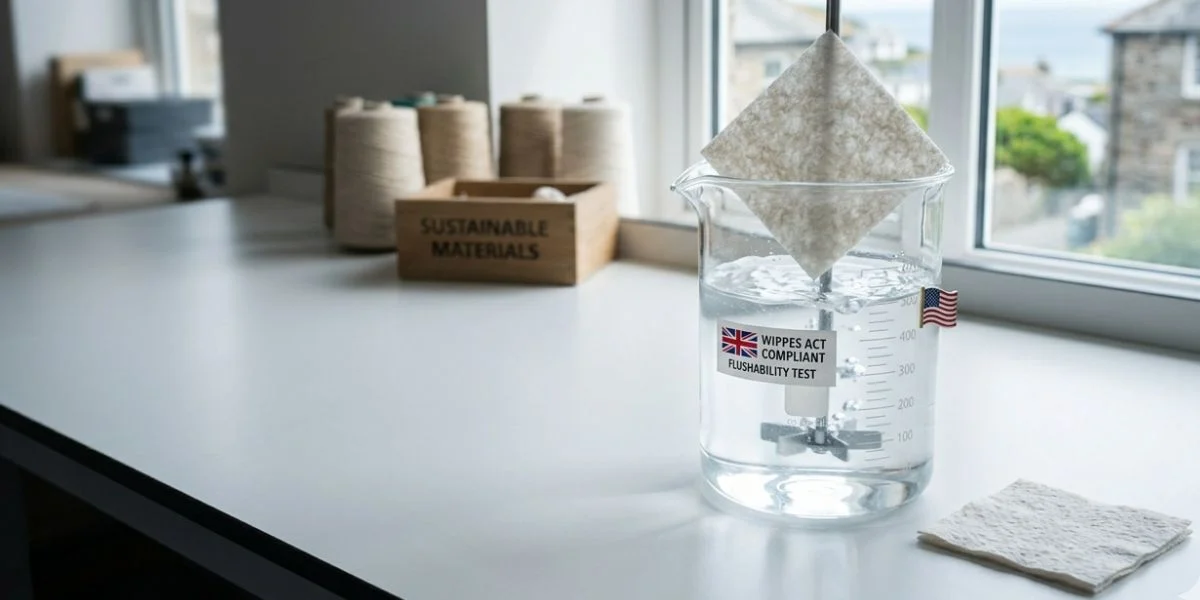
Compliant flushable nonwoven fabric must perform against recognized international standards. Favourite Fab substrates are designed to meet or facilitate passing of:
- INDA/EDANA GD4 and GD5 Flushability Guidelines — the primary international framework referenced by the WIPPES Act
- Slosh Box Test — simulates household flushing turbulence
- Toilet Paper Tube Test (TPPT) — basic dispersibility benchmark
- Dynamic Pressure Flow Test (DPFT) — simulates pressure through pipes
- Column Float Test — settling behavior in wastewater
We provide material data sheets and fiber certification documents that support your product-level compliance testing submissions.
Supply Chain Advantages for US Market Brands
Transitioning your supply chain to WIPPES Act compliant substrates requires a reliable manufacturing partner. Favourite Fab offers:
- Bulk roll production with consistent fiber composition across lots
- Custom GSM and width to match your converting line specifications
- Lot traceability documentation supporting your compliance records
- Competitive wholesale pricing — request a quote for volume requirements
- Export experience to North America, Europe, and Southeast Asia
Frequently Asked Questions
Does the WIPPES Act apply to international manufacturers supplying US brands?
Yes. Any nonwoven fabric or finished wipe product sold into the US market under a “flushable” claim must meet WIPPES Act standards, regardless of where manufacturing occurs. US brands sourcing from international suppliers are responsible for ensuring their raw material substrate is compliant.
Can polypropylene spunlace be used for WIPPES Act compliant flushable wipes?
No. Polypropylene is a synthetic plastic fiber that does not disperse in wastewater. The WIPPES Act specifically prohibits labeling wipes containing persistent synthetic fibers as “flushable.” Cellulose, viscose, and natural fiber substrates are the compliant alternatives.
What is the minimum order quantity for cellulose spunlace rolls from Favourite Fab?
We supply B2B buyers with minimum orders starting at 1,000 kg per fabric type. Custom specifications including GSM, width, surface pattern, and fiber blend are available at standard wholesale MOQs. Contact our sales team for exact pricing and lead times.
Do you provide test reports or certificates with your cellulose spunlace fabric?
Yes. We provide material composition certificates, fiber sourcing documentation, and standard physical test reports (tensile strength, elongation, GSM verification) with each bulk order. These support your own flushability compliance testing and regulatory submissions.
How quickly can you supply WIPPES Act compliant fabric for new product launches?
Standard lead times for bulk cellulose spunlace rolls are 3–6 weeks from order confirmation, depending on specification complexity and volume. Rush production slots may be available — discuss your timeline with our sales team.
Partner with Favourite Fab for Regulatory-Ready Flushable Nonwoven Fabric
The WIPPES Act compliance deadline is not a future concern — enforcement and market pressure from US retailers and municipalities are already active. Favourite Fab gives B2B buyers a direct manufacturing source for US WIPPES Act compliant flushable nonwoven fabric with the documentation, custom specifications, and wholesale pricing that procurement teams need. Request a material sample or wholesale quote today to begin your supply chain transition.
Related B2B Resources

Gaurav Garg
I'm Gaurav Garg, CEO of Favourite Fab, a company on a mission to revolutionize the nonwoven industry with sustainable practices. We work hand-in-hand with manufacturers and suppliers who share our commitment to eco-friendly production. With a deep interest in textile innovation, I'm passionate about educating consumers about sustainable material options and their potential to transform the nonwoven landscape.


