

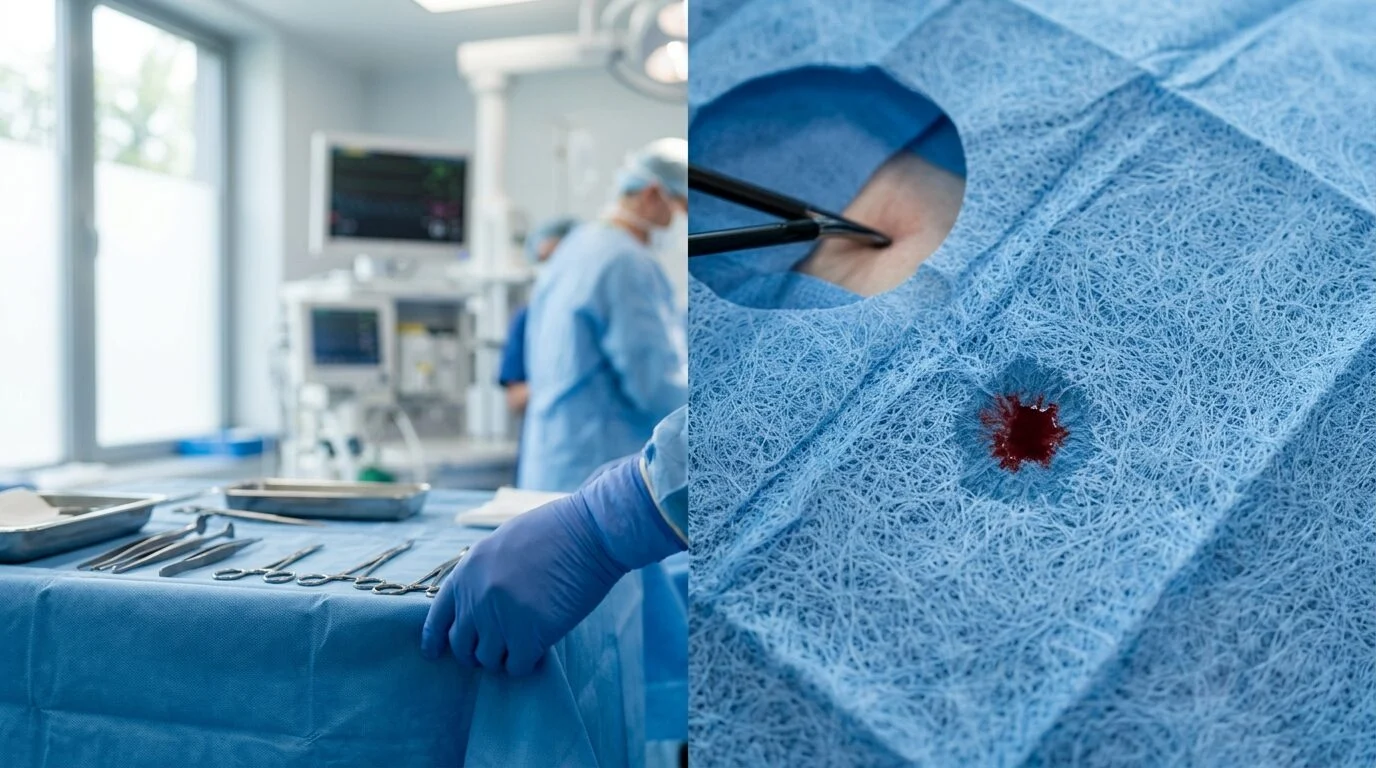
Spunlace Nonwoven Fabric for Medical Drapes — Absorbent, Fluid Management Layer
Spunlace Nonwoven Fabric for Medical Drapes is a critical raw material for B2B manufacturers. As India’s leading spunlace nonwoven fabric manufacturer, Favourite Fab supplies medical drapes grade spunlace in 50–120 GSM from our Agra facility — direct to OEM converters, wipe manufacturers, and hygiene brands across India and 30+ export markets.
Why Spunlace Nonwoven for Medical Drapes?
Spunlace nonwoven is produced by hydroentanglement — high-pressure water jets entangle fibres without chemical binders. The result is a soft, strong, lint-free sheet with exceptional absorbency and drape. Key advantages for medical drapes applications:
- High absorbency — viscose fibres absorb 8–12× their weight in liquid
- Softness — no thermal bonding = no hard fibre junctions = cloth-like feel
- Strength — hydroentanglement creates mechanical bonding that survives wet use
- No binder — no latex or chemical binder = clean, safe for skin and food contact
- Biodegradable option — 100% viscose grade composts within 90–180 days
Technical Specifications
| Parameter | Specification |
|---|---|
| GSM range | 50–120 GSM |
| Fibre blend | viscose/polyester 70/30, 100% viscose |
| Width | 160–320 cm |
| Tensile strength (MD) | 80–400 N/5cm depending on GSM |
| Absorbency | 800–1,200% of fabric weight |
| pH | 6.5–7.5 (EDANA 70.2) |
| Roll length | 500–2,000m per roll |
| MOQ | 500 kg per specification |
Why Source from Favourite Fab?
- Direct manufacturer — factory in Agra, India. No middleman pricing.
- Custom slitting — any width 3–320 cm, tolerance ±1 cm
- Multiple fibre blends — viscose, polyester, cotton, organic cotton, lyocell in-house
- COA per batch — GSM, tensile, absorbency, pH test report
- Sample rolls 3–5 days — qualify on your production line before bulk order
For full product range see our medical nonwoven fabric pillar page. Related: spunlace nonwoven fabric.
Frequently Asked Questions
What layer in a surgical drape uses spunlace?
Surgical drapes are multi-layer constructions. Spunlace serves as the absorbent inner layer (between the patient and the outer SSMMS barrier layer). It absorbs blood and fluid from the surgical site while the outer SMS/SSMMS prevents strikethrough.
What absorbency is required for surgical drape spunlace?
Drape-grade spunlace must absorb minimum 800% of its weight per ISO 9073-6. Our viscose spunlace achieves 900–1,200% absorbency at 70–120 GSM, meeting EN 13795 surgical drape material requirements.
What width do you supply for surgical drape production?
160–320 cm full-width rolls for drape manufacturers. Custom slit widths 30–100 cm for specific drape panel formats. Roll length 500–1,500m depending on GSM.
B2B Applications & End-Uses
Spunlace nonwoven as the absorbent inner layer in surgical drape construction is specified by medical textile OEMs supplying operating theatre drape packs to hospital procurement departments, surgical group purchasing organisations (GPOs), and sterile supply distributors across the EU, GCC, and Asian hospital markets. A surgical drape functions as a sterile barrier field around the surgical site — the outer SMS or SMMS layer provides primary liquid penetration resistance, while the spunlace inner layer provides the fluid absorption capacity that prevents pooled irrigation fluid, blood, and antiseptic solutions from breaching the sterile field or creating a hydrostatic pressure gradient that overcomes the outer barrier’s AAMI PB70 rating.
Orthopaedic drape pack manufacturers — where irrigation volumes during arthroscopy, joint replacement, and spinal procedures can exceed 3–5 litres per procedure — specify high-GSM spunlace (60–80 GSM) inner layers with documented absorption capacity per EDANA ERT 10.4 to ensure the drape construction can manage fluid volumes without saturation breakthrough. Cardiovascular surgery drape manufacturers specify dimensionally stable spunlace that maintains planar integrity and does not bunch, shift, or collapse under fluid load during prolonged procedures — dimensional stability when saturated is a specification parameter distinct from raw absorption capacity. Ophthalmic drape OEMs use lighter spunlace inner layers (40–50 GSM) in compact aperture drape formats for cataract and vitreoretinal procedures where irrigation volumes are lower but sterile field maintenance is equally critical.
Laparoscopic drape manufacturers producing trocar site drapes, extremity drapes, and body area drapes for minimally invasive surgery segments source spunlace inner layers in custom widths and pre-cut formats compatible with automated drape assembly lines. Hospital reprocessing services (third-party reusable drape laundry and sterilisation providers) source spunlace inner layer material for remanufacture of recovered reusable drape constructions, requiring spunlace grades that retain tensile and absorption properties across a validated number of industrial wash and steam sterilisation cycles.
Certifications & Quality Assurance
Spunlace nonwoven for surgical drape inner layers is tested per ISO 13795-1 (surgical gowns and surgical drapes — requirements and test methods), covering liquid penetration resistance (EN 13726-1 for composite systems), lint generation (EDANA ERT 50.5), and tensile properties (EDANA ERT 20.2-89) in both machine and cross directions under wet and dry conditions. Wet tensile retention is a critical specification parameter — surgical drape inner layers must maintain structural integrity when fully saturated with saline or antiseptic irrigation fluid to prevent delamination from the outer barrier layer during use.
AAMI PB70 composite system barrier performance is validated for drape constructions incorporating Favourite Fab spunlace inner layers, with test data available at Level 1, Level 2, and Level 3 configurations depending on outer barrier layer specification. ISO 13485:2016 production controls govern all surgical drape-grade spunlace manufacturing, with full batch traceability and 10-year record retention. Sterilisation compatibility — both EO and gamma — is validated per ISO 10993-7 and ISO 11137 respectively, with test data provided per production lot for OEM technical file inclusion.
Absorption capacity per unit area is tested per modified EDANA ERT 10.4 under standardised loading to characterise performance under the compressive conditions of a fluid-loaded drape in use. OEKO-TEX Standard 100 Class II certification is active for skin-contact healthcare textile grades. Lot-level certificates of analysis covering all key physical and functional parameters are issued with each delivery — contact our B2B medical textiles team for the full test parameter list relevant to your drape construction specification.
More Questions Answered
How is dimensional stability when saturated measured for surgical drape spunlace, and why does it matter?
Dimensional stability when saturated is assessed by measuring the change in machine-direction and cross-direction dimensions of a spunlace specimen before and after full saturation in 0.9% saline solution under a defined compressive load — mimicking the in-use condition of a fluid-loaded drape pressed against a surgical table or patient surface. Unstable spunlace that elongates or contracts significantly under fluid load creates wrinkling, gap formation at drape apertures, and risk of sterile field compromise through drape movement. Favourite Fab tests wet dimensional stability per an internal protocol derived from EN ISO 5077 dimensional change on washing, adapted for saline saturation conditions. For custom drape constructions, dimensional stability data is provided alongside absorption capacity data to enable full fluid management performance modelling before your drape validation programme commences.
Can Favourite Fab supply spunlace inner layer material pre-bonded to SMS outer layer as a finished drape composite?
Yes. Favourite Fab offers SMS + spunlace composite lamination as a value-added service for surgical drape OEMs seeking to reduce in-house lamination steps and supplier count. The composite is produced by thermal point bonding or ultrasonic lamination of the spunlace inner layer to an SMS or SMMS outer barrier, with bonding parameters validated to maintain both the outer layer’s liquid penetration resistance (AAMI PB70) and the inner layer’s absorption capacity and lint performance. Composite roll format, width, and bonding pattern are configurable — contact our B2B industrial textiles team with your drape construction drawing and performance specification for a composite feasibility assessment and sample programme quote.
📋 Related: Spunlace Nonwoven Fabric — Full Range & Specs | All Nonwoven Products from Favourite Fab
Related B2B Resources

Gaurav Garg
I'm Gaurav Garg, CEO of Favourite Fab, a company on a mission to revolutionize the nonwoven industry with sustainable practices. We work hand-in-hand with manufacturers and suppliers who share our commitment to eco-friendly production. With a deep interest in textile innovation, I'm passionate about educating consumers about sustainable material options and their potential to transform the nonwoven landscape.


