

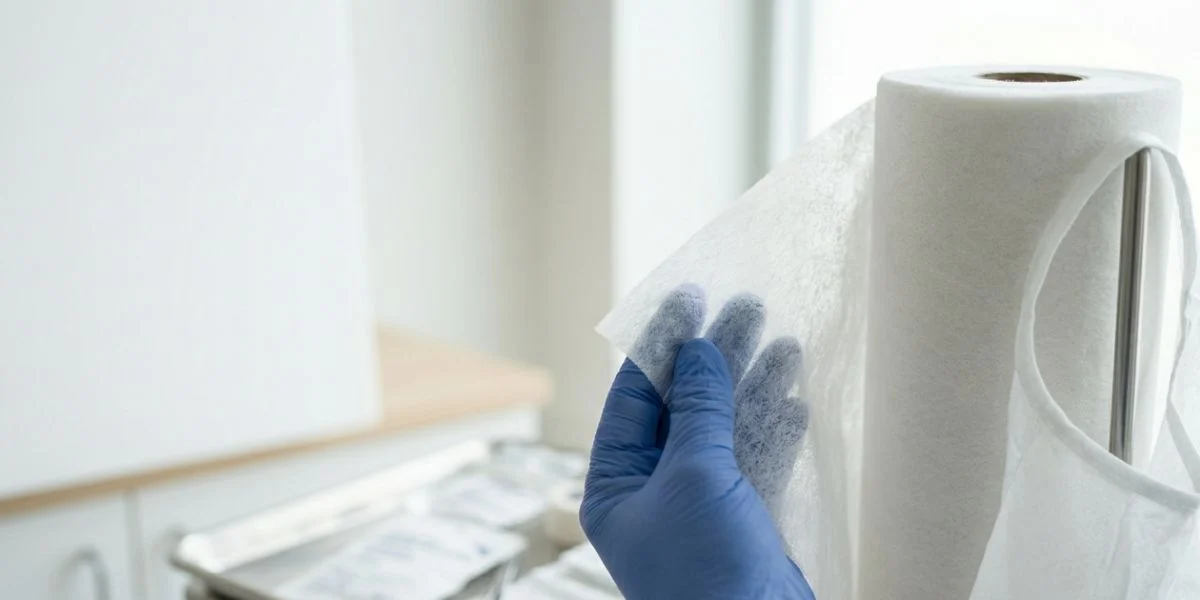
Spunlace Nonwoven Fabric for Surgical Gowns — Soft Barrier Layer Raw Material
Spunlace Nonwoven Fabric for Surgical Gowns is a critical raw material for B2B manufacturers. As India’s leading spunlace nonwoven fabric manufacturer, Favourite Fab supplies surgical gowns grade spunlace in 40–80 GSM from our Agra facility — direct to OEM converters, wipe manufacturers, and hygiene brands across India and 30+ export markets.
Why Spunlace Nonwoven for Surgical Gowns?
Spunlace nonwoven is produced by hydroentanglement — high-pressure water jets entangle fibres without chemical binders. The result is a soft, strong, lint-free sheet with exceptional absorbency and drape. Key advantages for surgical gowns applications:
- High absorbency — viscose fibres absorb 8–12× their weight in liquid
- Softness — no thermal bonding = no hard fibre junctions = cloth-like feel
- Strength — hydroentanglement creates mechanical bonding that survives wet use
- No binder — no latex or chemical binder = clean, safe for skin and food contact
- Biodegradable option — 100% viscose grade composts within 90–180 days
Technical Specifications
| Parameter | Specification |
|---|---|
| GSM range | 40–80 GSM |
| Fibre blend | polyester/viscose 50/50, 100% polyester |
| Width | 160–260 cm |
| Tensile strength (MD) | 80–400 N/5cm depending on GSM |
| Absorbency | 800–1,200% of fabric weight |
| pH | 6.5–7.5 (EDANA 70.2) |
| Roll length | 500–2,000m per roll |
| MOQ | 500 kg per specification |
Why Source from Favourite Fab?
- Direct manufacturer — factory in Agra, India. No middleman pricing.
- Custom slitting — any width 3–320 cm, tolerance ±1 cm
- Multiple fibre blends — viscose, polyester, cotton, organic cotton, lyocell in-house
- COA per batch — GSM, tensile, absorbency, pH test report
- Sample rolls 3–5 days — qualify on your production line before bulk order
For full product range see our medical nonwoven fabric pillar page. Related: spunlace nonwoven fabric.
Frequently Asked Questions
Is spunlace used as the outer layer of surgical gowns?
Spunlace is used as the inner comfort layer (next-to-skin) and as absorbent panel reinforcement in SMS-based gowns. The outer barrier layer is typically SMS or SSMMS nonwoven for fluid resistance.
What standard applies to surgical gown spunlace?
AAMI PB70 (Level 1–4) governs surgical gown barrier performance. The comfort liner layer (spunlace) must comply with biocompatibility requirements per ISO 10993 for skin-contact medical devices.
Can Favourite Fab supply EO-sterilisation compatible spunlace for gowns?
Yes. Our polyester/viscose spunlace is EO sterilisation compatible at 54–60°C. Residual EO degasses within 24 hours aeration. Sterilisation compatibility declaration provided on request.
B2B Applications & End-Uses
Spunlace nonwoven as a soft barrier layer in surgical gown construction is specified by medical textile OEMs producing both disposable single-use gowns and the inner comfort layer of reusable gown systems. In disposable surgical gown construction, spunlace is used as the inner facing layer laminated against an SMS or SMMS outer barrier, providing the skin-contact softness and low-lint surface that surgeons and scrub nurses require during procedures lasting 2–8 hours. The tactile comfort advantage of spunlace over standard SMS or nonwoven inner layers reduces surgical team fatigue and minimises gown removal requests mid-procedure — a compliance factor valued by hospital infection control departments.
AAMI PB70 Level 1 and Level 2 classified drape and gown reinforcement panels incorporate spunlace as a secondary layer at high-splash-risk zones — primarily the chest panel and forearm cuffs of surgeon gowns — where the spunlace layer contributes absorbency to intercept fluid before it reaches the outer barrier membrane. Contract manufacturers supplying pre-assembled surgical procedure packs to hospital group purchasing organisations (GPOs) in the EU and GCC markets specify spunlace gown inner layers with low lint per INDA/EDANA ERT 50.5 to meet sterile field contamination requirements. Reusable surgical gown manufacturers use spunlace as a comfort facing on polyester woven barrier shells, where the spunlace layer is bonded via ultrasonic welding or needle-punching to the outer shell.
Veterinary surgical gown manufacturers — an underserved segment in India — source spunlace inner layers for large-animal surgical packs, where extended procedure times and elevated physical demands on gown integrity increase the value of high-tensile, low-lint spunlace over standard PE-film inner facings. OEM manufacturers of isolation gowns for biosafety applications (BSL-2, BSL-3 facility protocols) specify spunlace inner layers for its launderability and retention of barrier properties across repeated decontamination cycles.
Certifications & Quality Assurance
Spunlace nonwoven for surgical gown applications is tested for lint generation per EDANA ERT 50.5, with production lots verified to meet ≤30 particles/cm² lint count — consistent with sterile field contamination requirements under ISO 13795-1 (surgical gowns and surgical drapes). Tensile strength in machine and cross directions is tested per EDANA ERT 20.2-89 to validate integrity under the physical stress of surgical use, including arm extension, gown donning/doffing, and fluid-saturated gown weight. Liquid penetration resistance for AAMI PB70 Level 1 and Level 2 composite systems incorporating spunlace layers is validated per AAMI TIR11 test protocols.
ISO 13485:2016 quality system controls govern production of surgical gown-grade spunlace, with risk management integration per ISO 14971 for medical textile applications. OEKO-TEX Standard 100 Class II certification confirms absence of harmful substances in skin-contact healthcare textile grades. For EO-sterilised disposable surgical gown applications, spunlace inner layers are validated for EO residual compatibility per ISO 10993-7. Biocompatibility screening data per ISO 10993-1 (cytotoxicity, skin sensitisation) is available to support CE marking technical files under EU MDR for surgical gown products classified as medical devices in the EU regulatory environment. Certificates of analysis per production lot include basis weight, tensile, lint count, and applicable certification references.
More Questions Answered
What is the AAMI PB70 classification relevant to spunlace layers in surgical gown construction?
AAMI PB70 defines four levels of liquid barrier performance for protective apparel used in healthcare settings. Level 1 (impact penetration per AATCC 42) and Level 2 (hydrostatic pressure per AATCC 127) are the classifications most commonly applied to surgical gowns incorporating spunlace as a comfort or absorbent inner layer within a composite barrier construction. The spunlace layer itself is not individually classified to AAMI PB70 — the classification applies to the finished gown or composite laminate assembly, where the SMS or SMMS outer layer provides the primary liquid barrier and the spunlace inner layer contributes absorbency and comfort. Surgical gown OEMs specifying spunlace from Favourite Fab should provide their composite construction specification for barrier performance correlation testing.
How does low-lint spunlace compare to SMS in terms of particle shedding in sterile field environments?
SMS (spunbond-meltblown-spunbond) nonwoven achieves low lint through its continuous filament spunbond outer layers, which resist fibre shedding. However, the meltblown core is mechanically fragile under abrasion — surgical gown sleeve contact with instrument tray edges or table surfaces can generate meltblown fibre fragments that are invisible but measurable in particle counts. Spunlace nonwoven, produced by hydroentangling staple fibres into a mechanically interlocked web, sheds primarily blunt-ended fibre fragments rather than fine meltblown particles under abrasion — producing a different particle profile that some sterile field protocols treat more favourably. Favourite Fab recommends requesting comparative lint count data (ERT 50.5) for both materials under your specific abrasion conditions before making a final material selection for gown inner layer specification.
📋 Related: Spunlace Nonwoven Fabric — Full Range & Specs | All Nonwoven Products from Favourite Fab
Related B2B Resources

Gaurav Garg
I'm Gaurav Garg, CEO of Favourite Fab, a company on a mission to revolutionize the nonwoven industry with sustainable practices. We work hand-in-hand with manufacturers and suppliers who share our commitment to eco-friendly production. With a deep interest in textile innovation, I'm passionate about educating consumers about sustainable material options and their potential to transform the nonwoven landscape.


